Quick Summary
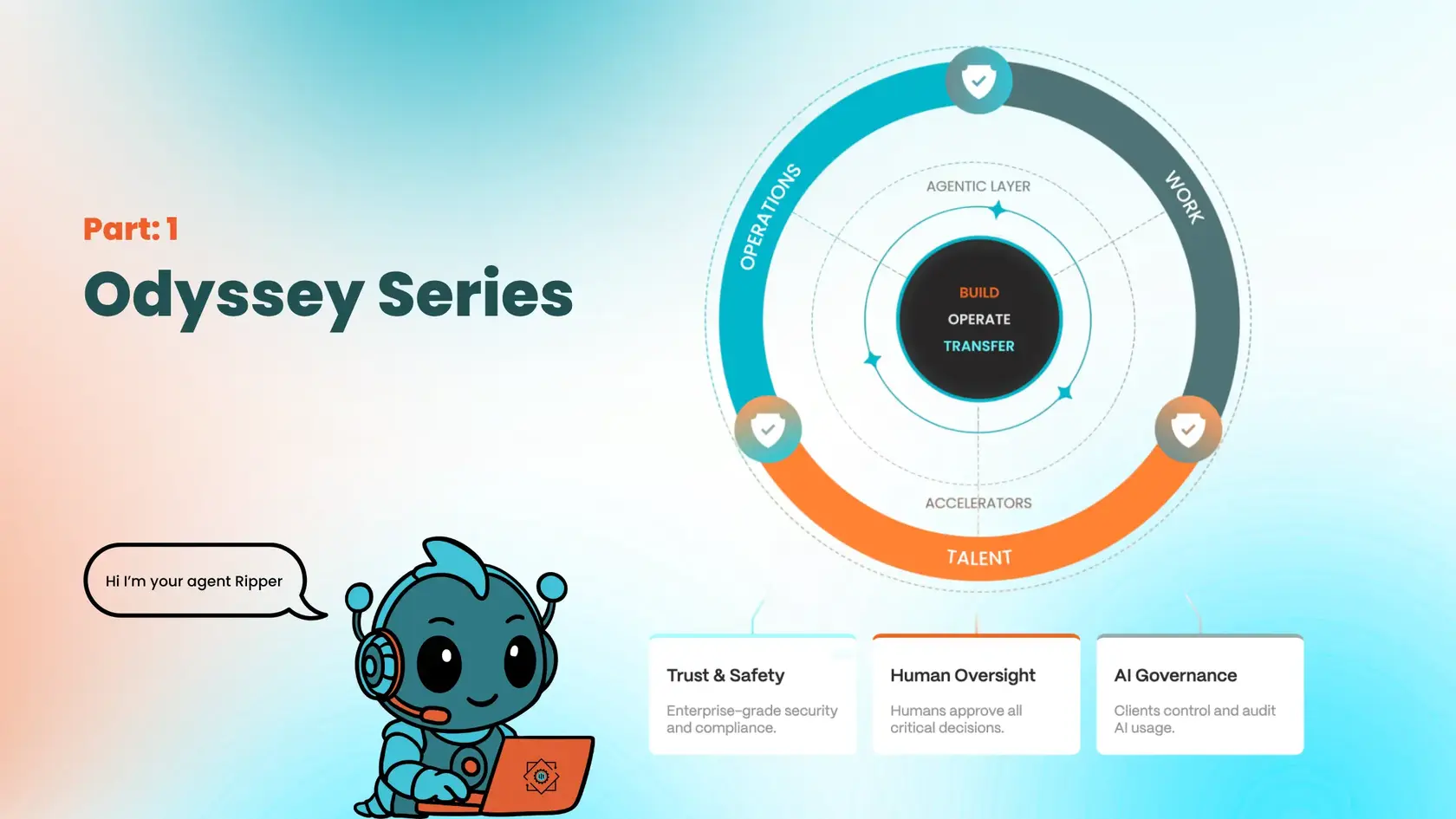
Odyssey is BOT's operating system for building & scaling GCCs. Proven inside BOT's own teams as Customer Zero for over a year, it now powers 8+ GCCs, connecting Talent, Work and Operations.
Key Takeaways
- An Agentic AI GCC is not defined by the number of agents it deploys, but by how effectively people and intelligent systems work together to own outcomes.
- Odyssey connects Talent, Work and Operations into one operating system- with governance, culture and human judgment built in.
- Proven within BOT as Customer Zero, Odyssey now supports more than eight GCCs across the Salesforce, Snowflake, AWS, ServiceNow and Anthropic ecosystems.
This series follows BOT’s journey from building GCCs, to turning what we learned into Odyssey, to redesigning that operating system for humans and our digital workforce (agents) working together.
Across the three parts, we move from experience to execution and to delivering enterprise value: what we learned from building GCCs, how those lessons are being put into real workflows, and what that changes about the capability and ownership a modern GCC can take on.
As access to capable agentic models becomes easier, the harder problem is no longer getting the technology. It is putting intelligence to work in a way that creates lasting capability.
The Operating System Is the Part That Lasts
When you sit in enough customer conversations, a version of the same question eventually comes up: is there a simpler way to do this?
A simpler way to stand up a GCC without adding another layer of operational complexity. A simpler way to scale talent, governance, delivery and culture without rebuilding the machinery every time. A simpler way to introduce AI without adding another disconnected set of tools, workflows and risks for leaders to manage.
We know there is. At BOT, we call it Odyssey; our operating system for building and scaling global capability centers (GCCs).
We can say that confidently because the idea behind Odyssey did not start with a platform. It comes from years spent building, scaling and operating global capability centers across ecosystems such as Salesforce, Snowflake, AWS, ServiceNow and Anthropic; across different stages of growth and from the lessons accumulated along the way. That accumulation of experience is what makes simplification possible.
Simple does not mean removing the complexity of building a GCC. It means having seen enough, to know what good looks like.
The modern GCC ambition
The GCC conversations around cost and capacity are ancient. The more interesting question is what the center can eventually own.
Tercera’s research shows that 61% of AI-native organizations are expanding their global delivery capacity, compared with 51% overall. AI is raising the need for GCCs built to own capability, intelligence and outcomes. But expanding capacity and building ownership are not the same thing.
A GCC can look healthy by conventional measures and still remain dependent underneath. The real test is whether it can take responsibility for products, platforms and outcomes; whether local leaders have the context and authority to make decisions; and whether the center can build IP, improve customer outcomes and create capabilities the wider organization relies on. The weakness usually becomes visible when strong execution is asked to become real ownership.
An operating system addresses that underlying problem. It creates enough structure around how people, knowledge, decisions and work come together that the center does not have to depend on whoever happens to be in the room.
For us, that has always included culture. When complexities rises, we always come back to our #1 value of customer centricity, our experience has been that building a valuable GCC starts with people who understand the partner's values, have the confidence to work directly with customers and are developed toward a common outcome. Culture, in that sense, is not something to preserve after the operating system is built. It is an invaluable input.
From experience to an operating system
Odyssey grew gradually from that thinking.
As we built more teams, we started asking what we should carry forward. A hiring practice that consistently found better people should not have to be rediscovered. A learning program that shortened the path to capability should become reusable. A governance rhythm that improves decision-making should become a starting point for the next center.
In that sense, the operating system is the closest thing an organization has to something immortal.
Not everything becomes a process. Some experience becomes best practice, some evolve into training, and some remains human judgment. But when something proves repeatable, we can institutionalize it, improve it and give the next team a stronger starting point.
Today, we are applying this operating science across more than eight GCCs, while using BOT as Customer Zero to test and strengthen Odyssey from within. The real learning lies beneath the growth: building deep technical capability, developing local leadership, embedding culture and preparing teams to own meaningful outcomes.
Then AI changed what the operating system could do
AI has made the opportunity much larger.
Foundation systems are improving rapidly, and the market is already shifting its attention from simply consuming more AI toward creating measurable value from it. IBM has described this transition as moving from “tokenmaxxing” to “valuemaxxing”: AI usage itself is not the outcome. Systems can now work with private enterprise knowledge, reason across information, interact with tools and participate in multi-step workflows. That means an operating system no longer has to simply document how work gets done. Increasingly, it can help people do the work.
This is where our view of the Agentic GCC begins. EY describes the emerging Agentic AI GCC as an enterprise intelligence hub, where autonomous intelligence becomes part of the execution layer rather than another tool retrofitted onto old processes.
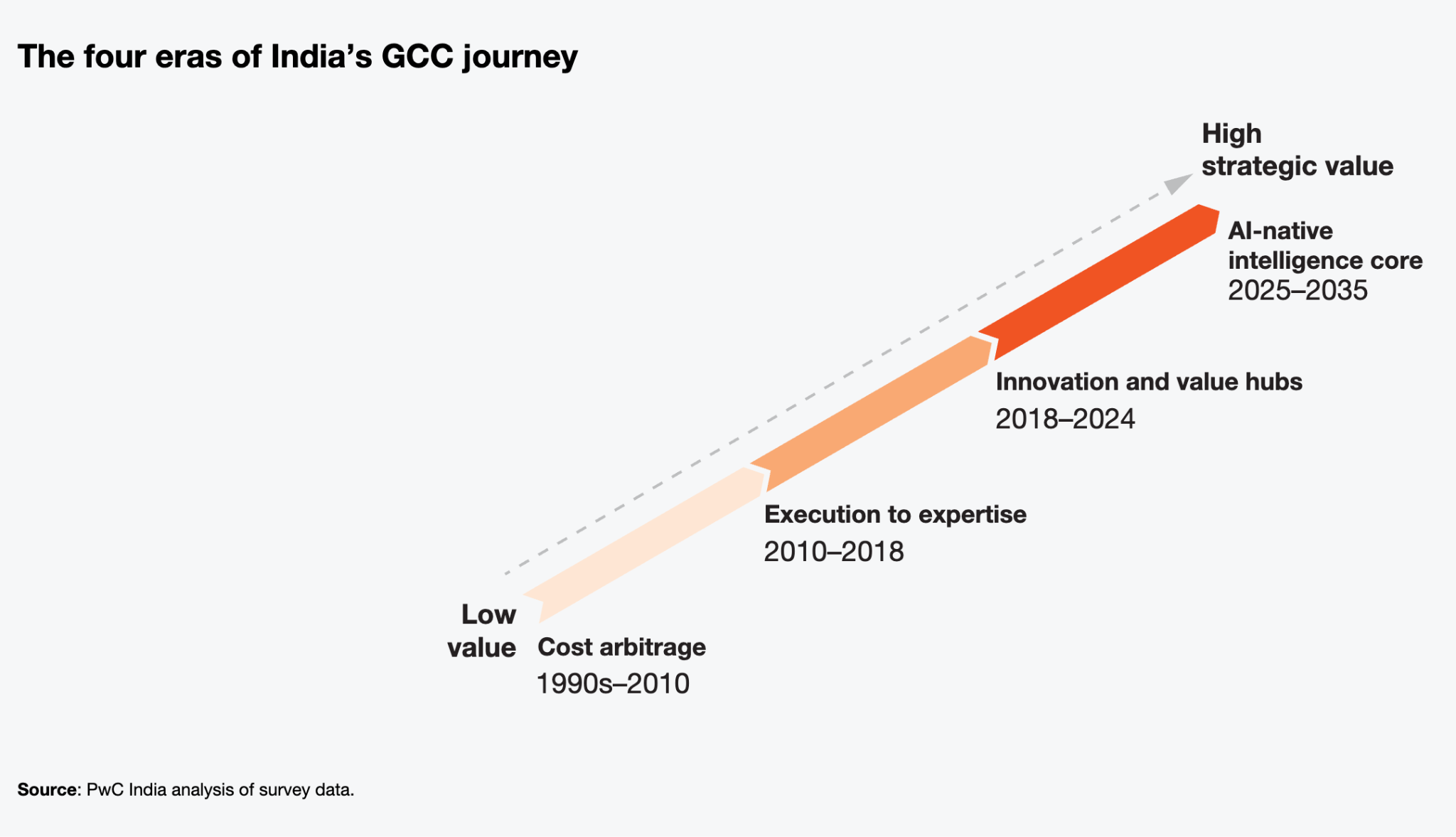
As systems become more capable and increasingly accessible, access to the system itself becomes less differentiating. The harder problem is implementation: connecting intelligence to the right enterprise context, workflows, systems, permissions and people. We believe this makes the GCC more strategically important in the AI era. It can become an AI-native intelligence core: close enough to the business to understand the work, technically deep enough to redesign it, and operationally mature enough to put AI into production responsibly.
Odyssey is evolving around this opportunity.
It has already been running live inside BOT for over a year, with our own teams as Customer Zero.
Today, it brings together three connected parts of the GCC: Talent, Work and Operations. Talent covers how people are found, developed and aligned. Work covers how teams deliver, collaborate and increasingly use intelligent systems. Operations brings together the governance, security, finance, compliance and infrastructure required to keep the center running well.
AI is increasingly making the connections between them more powerful. We are not trying to build a GCC with the maximum number of agents. We are trying to build one that gets better at owning outcomes, retaining knowledge, developing people and making good decisions as it scales.
Every partner gives us a new set of problems to understand. Every GCC gives us another operating environment to learn from. Every workflow teaches us something about where technology helps and where human judgment remains indispensable.
And there is one constraint no operating system can solve:
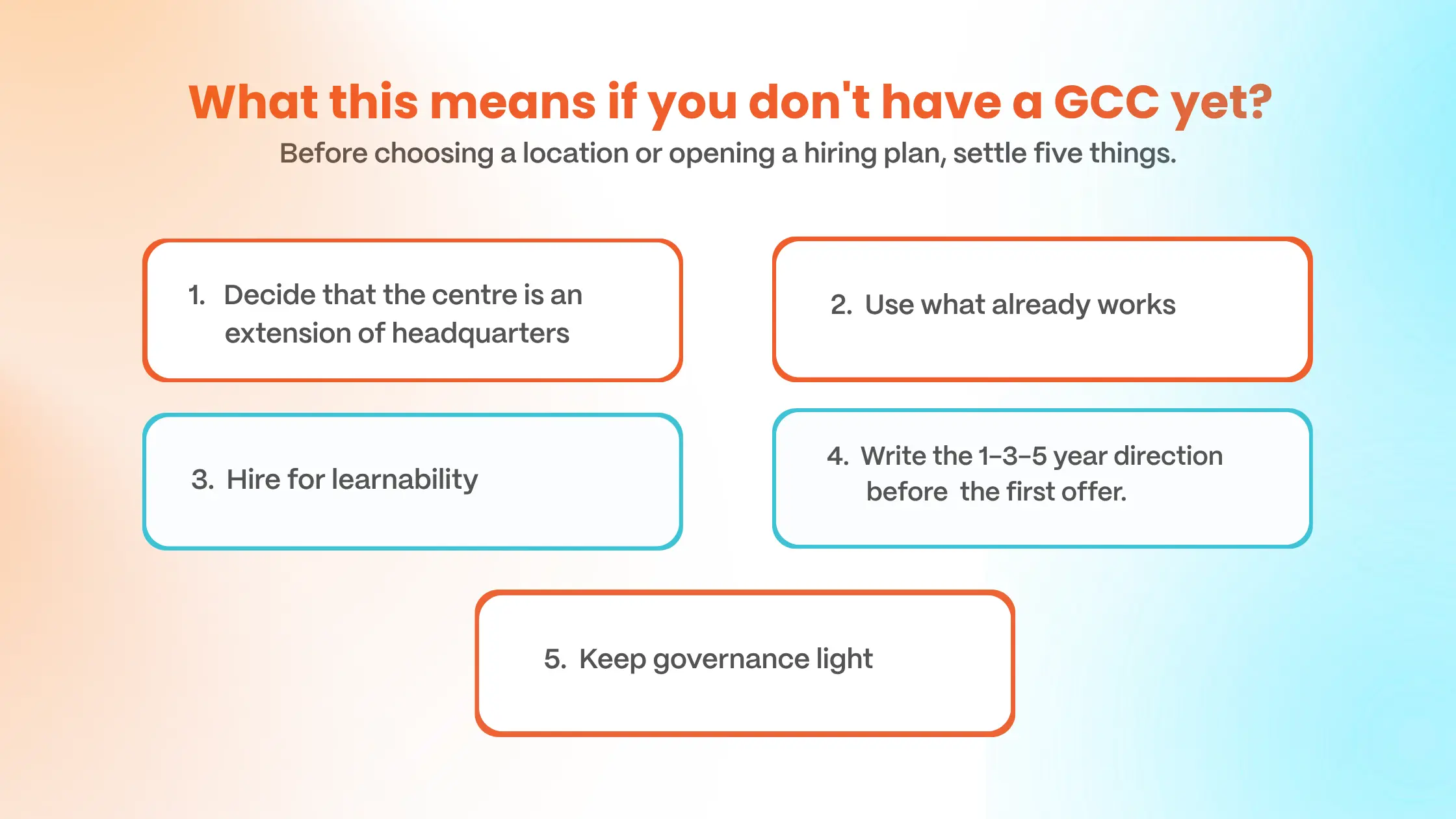
A strategy that isn't clear at headquarters will not become clearer with distance.
Because strategy should never become dogma. The moment we stop questioning our assumptions, we stop learning.
Technology will keep changing. Systems will change. The work will change too. That is why Odyssey is designed to keep evolving - and why we have been running it inside our own work first.
Odyssey is our way of turning years of experience into a stronger starting point for what comes next. And perhaps that brings us back to the question we started with: is there a simpler way to build the next generation of GCCs?
We believe there is, because we have spent years understanding the complexity well enough to turn it into an operating system. We call it Odyssey.