Quick Summary
Odyssey’s approach to agentic AI GCCs: Forward Deployed Engineers map how work really happens, then build, evaluate and govern AI workflows in production.
Key Takeaways
- The best AI opportunities appear in the gap between how work is documented and how it actually happens, so understanding the work has to come before building the agent.
- Two loops, the Quality Loop and the Value Loop, are what turn an AI demo into an operating capability.
- Not every road leads to an agent: metrics must follow value, autonomy needs its own operating system, and restraint is part of the architecture.
How BOT’s Forward Deployed Engineers take real workflows from discovery to production AI
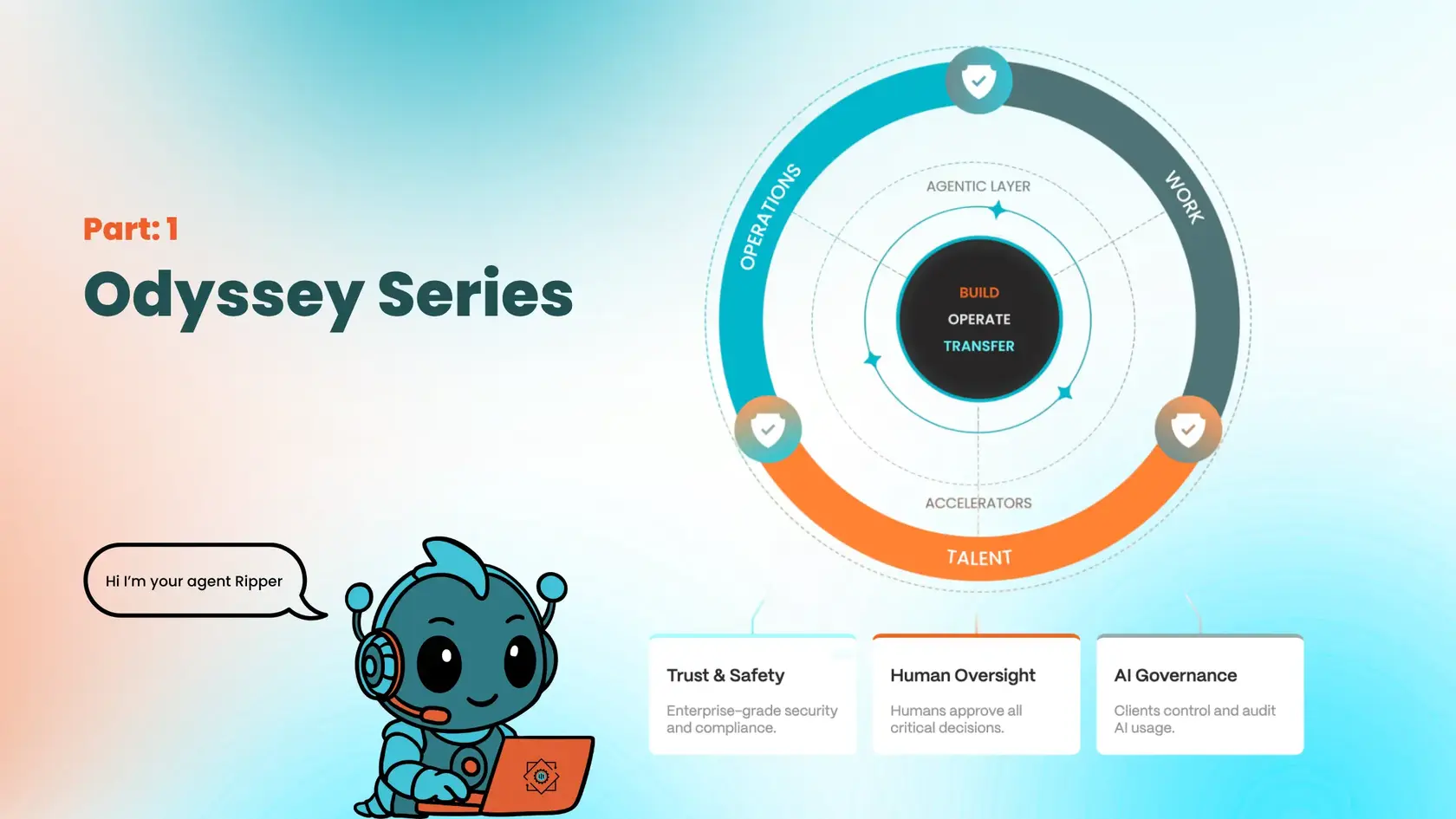
In Part One: Our journey towards building the Operating System for Agentic AI GCCs, we shared why Odyssey exists, and why the next generation of GCCs needs an operating system built for ownership, intelligence and scale. In Part Two, we go behind the scenes of how that operating system is being built:
The easiest place to begin an AI transformation is with technology. Open the system, find a process and build an agent.
We have increasingly come to believe that is the wrong order.
When we started building the Agentic layer of Odyssey, the question was not simply, “Where can we deploy an agent?”
It was more basic: How does the work actually happen?
That question has taken our Forward Deployed Engineers into talent workflows, learning programs and operating processes within BOT. They sit beside the subject-matter experts who perform the work and take what we call a trip down the execution lane: understanding how the workflow moves from beginning to end, where decisions are made, where data and context lives, which steps depend on human judgment and where the documented process starts to diverge from reality.
Process documentation tells us how work is supposed to happen. Sitting alongside the person doing it shows us how work actually happens. That gap is often where the most useful AI opportunities appear. The combination becomes the bedrock for redesign.
A trip down the execution lane
An FDE needs enough engineering depth to build secure, production-ready systems, but enough curiosity to understand why the business works the way it does. BOT’s current FDE pathway therefore begins with full-stack foundations - APIs, authentication, security, databases and application design - before moving into Claude APIs, tool use, RAG, structured outputs and multi-agent systems. Engineers then pair with business SMEs, shadow live workflows and begin identifying where intelligence can genuinely improve an outcome.
There is one requirement in the program that captures the philosophy particularly well: FDEs have to explain any AI-generated code they submit.
“AI-native engineering isn’t about letting AI write more code. It’s about knowing what to trust, what to question and what you’re willing to own in production.”
- Akshay Singh Thakur, Technical and AI Architect, Team Odyssey
This is also where being close to frontier AI matters. As an Anthropic partner, BOT is building with Claude while the capabilities themselves are moving quickly. But access to a frontier system is not the differentiator on its own. The harder work begins when that system meets a real operating environment: fragmented knowledge, unclear ownership, security boundaries, old systems and exceptions that were never written down.
Putting an agent onto a poorly understood workflow is a little like fitting a faster engine before checking whether the steering works. You may move faster, but not necessarily toward the outcome you wanted.
The FDE sits between those two worlds.
From workflow to production
Once the work is understood deeply enough, the build follows a disciplined path:
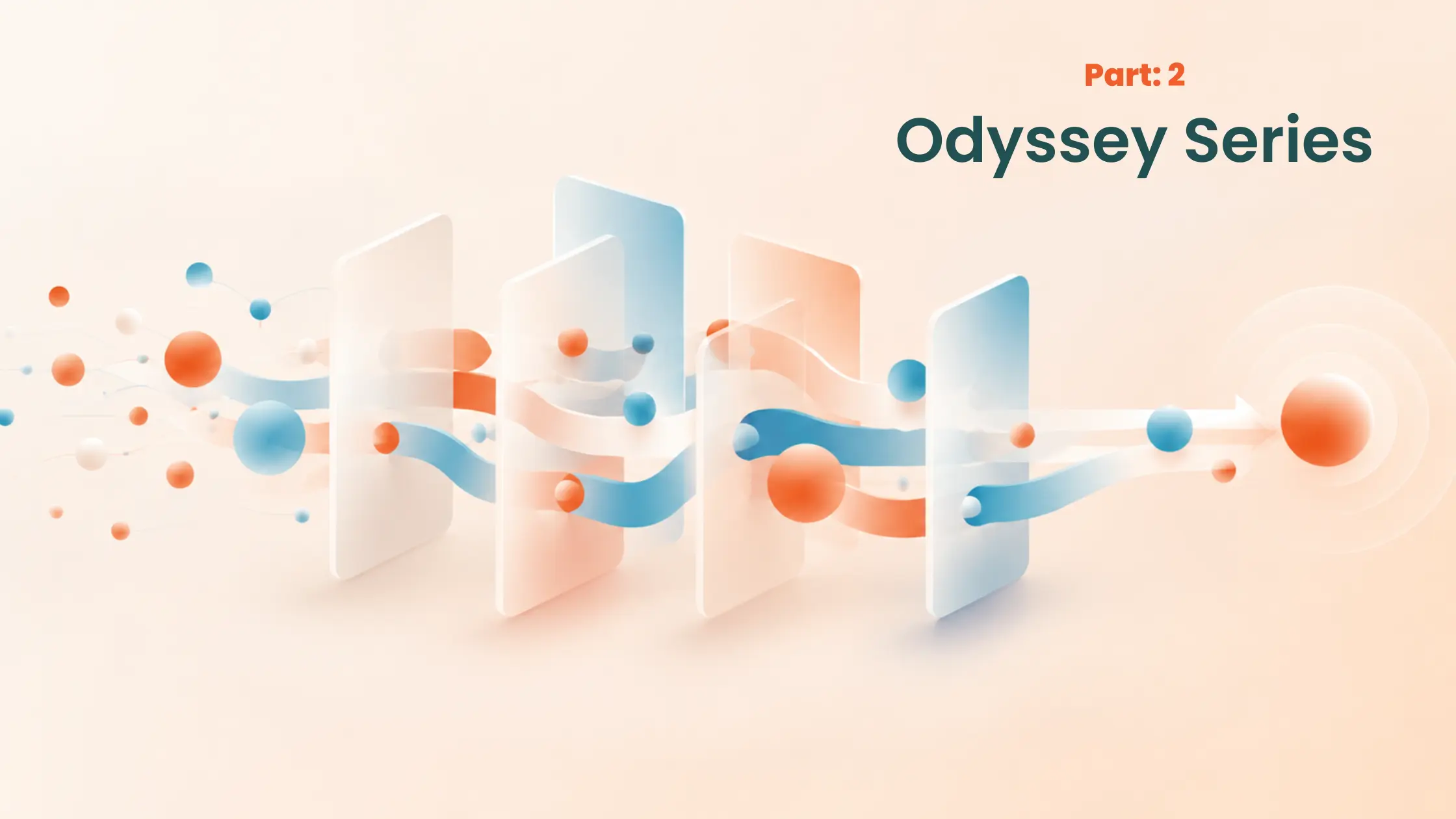
Discover → Design → Build → Evaluate → Iterate → Integrate → Monitor & Improve
The nine stages matter, but the more important part is the two loops running through them.
The first is the Quality Loop.
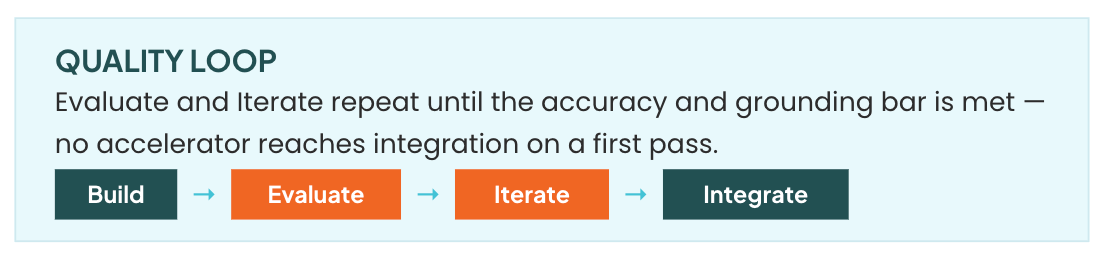
Build does not move straight into integration. Evaluation and iteration repeat until the accelerator reaches the required bar for accuracy, grounding, edge cases and performance.
The second is the Value Loop.
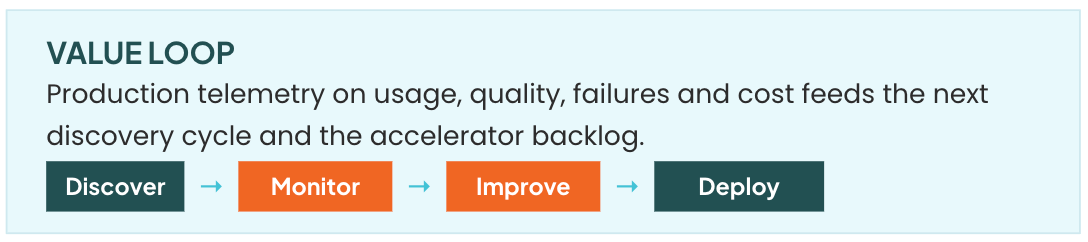
Once something reaches production, usage, quality, failures and cost feed back into the next discovery cycle. The workflow is not “finished” when it launches. Production becomes another source of learning.
That is the distinction between an AI demo and an operating capability.
Customer Zero: learnings from our own work
As customer Zero,our operating laboratory today spans Talent Acquisition, Learning & Development, Finance, workplace operations and enterprise knowledge.
In Talent Acquisition, we are working across a few high-value areas. The current focus is on demand intake, job-definition support and structured candidate matching, while much of the later-stage experience remains human.
Talent Acquisition: the impact
40% reduction in time-to-hire
30% improvement in candidate quality
25% increase in hiring-manager and candidate satisfaction
For a high-growth SI, the real operating gain is shortening the path from customer demand to deployable talent without lowering the quality bar. We saw that firsthand during AllCloud’s India GCC roadmap, linking six-week build-out with certification paths, governance, 24×7 delivery and the progression toward self-contained pods.
Learning & Development gives us another view of the same problem. The Content Builder and Evaluation Board combines AI-assisted content generation with human review, assignments, submissions and evaluation.
Learning & Development: the impact
175+ people supported across recent learning programs
4.75/5 learner feedback
30–35% efficiency gain from the evaluation accelerator
For companies scaling globally, growth depends on how quickly new talent can become market-ready expertise. That same principle showed up in Cloud for Good, where the bigger win was building technical depth and delivery ownership alongside team growth. The lesson: learning has to be embedded into the operating system as a core part of how capability is created.
Working on our own shared-services functions gave us more than a list of use cases. It gave us a clearer view of what actually separates AI experimentation from operating change. Three lessons have become especially important.
1. The metric has to follow the value
Tokens consumed, prompts sent, agents invoked, users activated, are easy to measure only matters for adoption and economics, but they are not the outcome.
You cannot communicate values you have not decided on first.
Before an accelerator is built, we increasingly ask what should actually become better if it works. Is the objective faster cycle time? Better quality? Faster decisions? Fewer errors? More capacity for higher-value work?
Our production methodology already tracks usage, quality, failures and cost. The harder and more useful work is tying those technical signals back to business KPIs. That is how AI moves from adoption to value.
2. Autonomy needs an operating system too
Once an agent can act, governance cannot sit in a policy document outside the workflow.
Odyssey's current Agentic Control Plane is therefore being built around identity and role-based access, enterprise knowledge, system policy, evaluations, audit and telemetry.
We summarize the design principle as:
The right intelligence. The right authority. The right human control. The right cost.
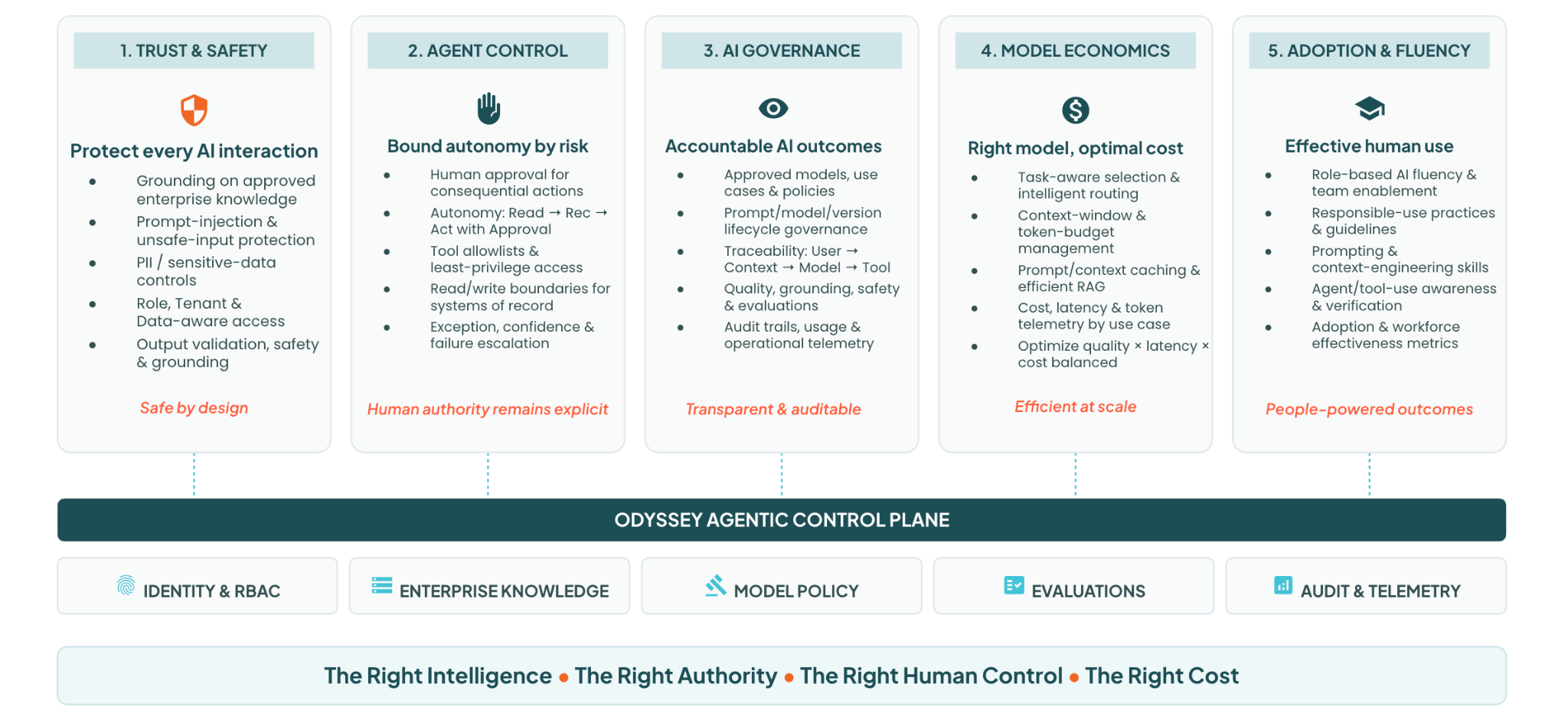
As systems become more capable, discipline becomes more important too. Moving at the frontier of AI does not mean allowing technology to dictate the operating system. It means understanding new capabilities early, testing them against real work, measuring where they create value and putting the right boundaries around them before they scale.
3. Not all road leads to an agent
Sometimes the data needs fixing. Sometimes the decision right is unclear. Sometimes the process itself should be redesigned before AI touches it. And sometimes the most responsible conclusion is that a decision should remain entirely human. That restraint is part of the architecture too.
Agentic operations,in our view, is redesigning work so humans and agents each contribute what they are uniquely good at toward a better outcome.
Some workflows will become highly agentic. Others will remain human-led with much better intelligence around them. Some ideas will fail the value test and never make it past discovery. That is exactly how it should work.
Odyssey is being built through this learning loop: FDEs and AI architects sitting beside SMEs, mapping reality, testing systems, putting selected workflows into production and measuring what genuinely gets better.
The frontier is moving quickly. So are we.
But our ambition is not to chase every new capability the moment it appears. It is to build the operating discipline that lets us use those capabilities well. That is the backstage story of Odyssey. Not a fashionable agentic transformation story but an understanding of the work deeply enough to redesign it. But that raises a bigger question: if everyone eventually has access to capable systems, where does the durable advantage actually sit?